

Did Rogue Star Change Makeup Our Solar System
It'due south known as HIP 85605, one of two stars that make upwardly a binary in the Hercules constellation roughly sixteen lite years away. And if a recent research paper produced by Dr. Coryn Bailer-Jones of the Max Planck Constitute for Astronomy in Heidelberg, Federal republic of germany is correct, information technology is on a collision course with our Solar System.
At present for the good news: co-ordinate to Bailer-Jones' calculations, the star volition laissez passer by our Solar Arrangement at a distance of 0.04 parsecs, which is equivalent to eight,000 times the altitude between the Globe and the Sun (8,000 AUs). In improver, this passage volition not affect World or any other planet's orbit effectually the Sun. And mayhap most importantly of all, none of it will be happening for another 240,000 to 470,000 years from now.
"Fifty-fifty though the milky way contains very many stars," Bailer-Jones told Universe Today via electronic mail, "the spaces between them are huge. So even over the (long) life of our galaxy and then far, the probability of any two stars have actually collided — as opposed to just coming close — is extremely small."
Nevertheless, in astronomical terms, that still counts as a near-miss. In a universe that is 46 billion low-cal years in any management – and that's simply the observable role of it – an issue that is expected to have place but l light days away is considered to be pretty close. And in the context of space and time, a quarter of a million to half a million years is the very most time to come.
The existent concern is the effect that the passage of HIP 85605 could take on the Oort Deject – the massive deject of icy planetesimals that surrounds the Solar Arrangement. Given that it's distance is betwixt twenty,000 and 50,000 AU from our Lord's day, HIP 85605 would actually move through the Oort cloud and cause serious disruption.
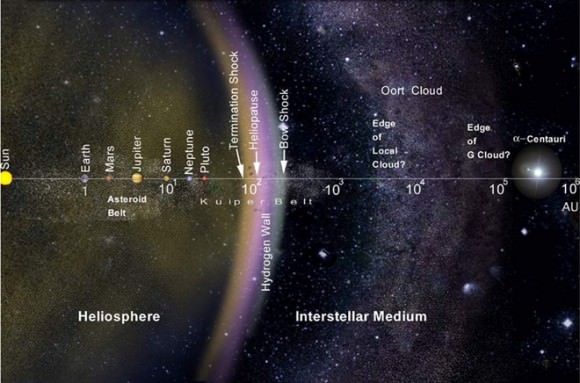
Many of these planetesimals could be blown off into infinite, but others could be sent hurtling towards Earth. Assuming humanity is withal around at this indicate in time, this could present a fleck of an inconvenience, even if it is spread over the class of a million years.
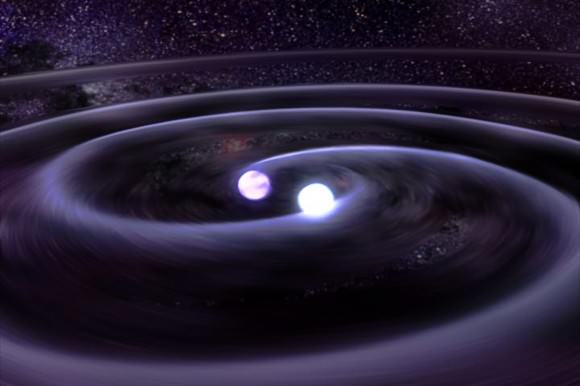
Every bit it stands, such "close encounters" betwixt stars are quite rare. Stellar collisions usually simply occur within binaries, where white dwarfs or neutron stars are concerned. "The exception to this is physically bound binary stars in a tight orbit," said Bailer-Jones. "It can and does happen that one star expands during its development and will then interfere with the evolution of the other star. Neutron-neutron star pairs can even merge."
But of course, on an astronomical timescale, stars passing each other by as they perform their cosmic trip the light fantastic is actually a pretty common occurrence. Equally role of Bailer-Jones larger report of over 50,000 stars within our galaxy, this "close run into" is i of several predicted to accept place in the coming years.
Of all of them, only HIP 85605 is expected to come within a single parsec between 240 and 470 thousand years from now. He also indicates with (xc% confidence) that the last fourth dimension such an encounter took place was three.eight 1000000 years ago when gamma Microscopii – a G7 giant which has two and a one-half times the mass of our Sun – came within 0.35-1.34 pc of our organisation, which may have caused a large perturbation in the Oort cloud.
On his MPIA webpage, in the study'south FAQ section, Bailer-Jones claims that his inquiry into stellar close encounters was motivated past a desire to study the potential impacts of astronomical phenomena on Globe, and is part of a larger program named "astroimpacts".
"I am interested in the history of the World," he says, "and astronomical phenomena have clearly played a role in this. But what part precisely, how meaning, and what tin can nosotros expect to happen in the futurity?" Whereas several studies accept been conducted in the by, he feels that the methods – which include assuming a linear relative movement of stars – produces inaccurate results."
In contrast, Bailer-Jones study relies on "more recent information or re-analyses of data to produce hopefully more authentic results, and then compensate more rigorously for the uncertainties in the data, so that I can adhere probabilities to my statements."
Equally a result of this, he predicts that HIP 85605 has a xc% take a chance of passing within a unmarried parsec of our Sun in the next 240 to 470 thousands years. However, he likewise admits that if the astronomy is incorrect, the next closest encounter won't be happening for another 1.iii million years, when a K7 dwarf known as GL 710 is predicted to pass inside 0.10 – 0.44 parsecs.
Bailer-Jones besides believes that the European Infinite Agency'due south Gaia spacecraft will help make more accurate predictions in the future. By agreement and mapping the environs of the Milky Way Galaxy, measuring the gravitational potential and determining the velocity of stars, scientists will be able to see how their various orbits around the galaxy'due south centre could cause them to intersect.
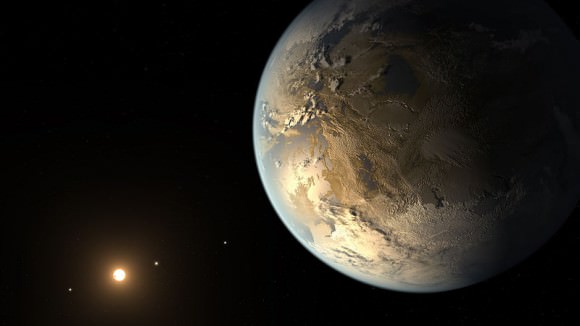
Simply mayhap the most interesting question explored on his webpage is the possibility of using stellar shut encounters every bit a shortcut for exploring exoplanets. According to current cosmological models, the bulk of stars within our galaxy are believed to host exoplanets.
And then if a star is passing us at simply a few parsecs (or even with a single parsec) why not hop on over and investigate its planets? Well, as Bailer-Jones indicates, that's non really a applied idea: "Traveling to a star passing our solar organization at a altitude of around 1 pc with a relative speed of xxx km/s is no easier than traveling the the nearby stars (the nearest of which is just over 1 pc abroad). And nosotros would have to wait 10s of thousands of years for the next encounter. If we can ever achieve interstellar travel, I don't suppose it would take that long to achieve, so why wait?"
Darn. Withal, if at that place's one thing this phenomena and Bailer-Jones study reminds u.s.a., it is that in the course of dancing around the heart of the Milky Fashion, stars are not fixed in a unmarried bespeak in space. Not only do they periodically move within reach of each other, they tin can besides have an bear upon on life within them.
Alas, the timescale on which such things happen, not to mention the consequences they entail, are so large that people here on Earth demand not worry. By the time HIP 85605 or GL 710 come within a parsec or two of united states of america, nosotros'll either be long-since dead or likewise highly evolved to care!
*Update: Co-ordinate to a new study posted by Erick E. Mamajek and associates on arXiv, the passage of the recently-discovered low mass star W0720 (aka. "Scholtz Star") – roughly 70,000 years agone and at a distance of 0.25 Parsecs from our Sun – was the closest encounter our Solar System has had with another star. They summate the possibility that it would accept penetrated the System's Outer Oort Cloud at 98%. Even so, they also estimate that the impact it would have had on the flux of long-period comets was negligible, but that the passage also highlights how "dynamically important Oort Cloud perturbers may exist lurking among nearby stars".
Having read the study, Bailer-Jones claims on the updated FAQ section of his MPIA webpage that their analysis appears to be correct. Based on the assumption that the star was moving on a abiding velocity relative to the Dominicus prior to the run into, he agrees that the calculations on the distances and timing of the passage are valid. While his own study identified a possible closer encounter (Hip 85605), he reiterates that the data on this star is of poor quality. Meanwhile, another close run across took place involving Hip 89825; just hither, the arroyo distance is estimated to have been 0.02 Parsecs larger. Hence, W0720 can be said to take been the closest run across with some degree of certainty at this time.
The study appeared on Feb. 16th at arXiv Astrophysics.
Further Reading: arXiv Astrophysics, Max Planck Institute of Astronomy
Source: https://www.universetoday.com/117778/rogue-star-hip-85605-on-collision-course-with-our-solar-system-but-earthlings-need-not-worry/
Posted by: millerdurs1999.blogspot.com
0 Response to "Did Rogue Star Change Makeup Our Solar System"
Post a Comment